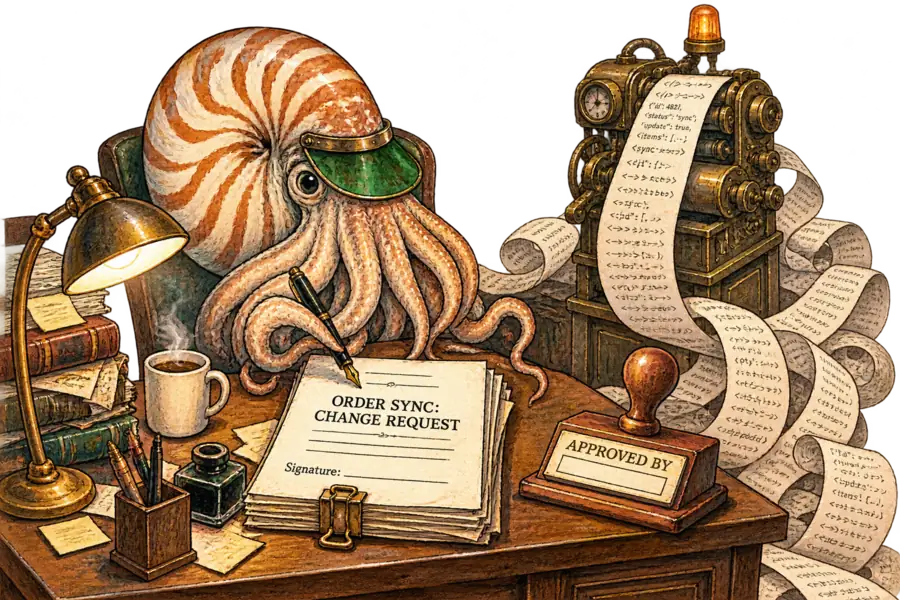
The Connector Wrote Itself. Somebody Still Has to Sign For It.
A vendor's sponsored warning that AI adoption is outrunning governance reads as a confession: in order, inventory and returns integration, writing the connector was never the expensive part. Being the person who certifies it still is.
Neritus Vale
Retail’s integration vendors have stopped selling speed. Celigo used a sponsored post in Modern Retail on 18 August to warn that “AI adoption is moving faster than governance,” and that it is now “easier than ever to paste a prompt, generate code and ship it, only to discover three weeks later” during a peak-season rush “that the order sync was wrong all along.” When the firm selling connectors argues that writing them is the easy part, the constraint in order, inventory and returns integration has moved from authorship to accountability.
The generation claim can be granted in full and the argument still holds. Google’s 2025 DORA report found 90% of technology professionals using AI at work, and higher adoption associated with rising software delivery throughput. It also found higher adoption associated with rising delivery instability, which is the same result read from the other end. More change is arriving each week in systems whose capacity to absorb change did not improve. The work did not vanish; it moved to whoever has to say the change is safe.
Integration is the worst place in retail to be wrong quietly. A broken checkout page fails visibly and gets fixed; a wrong field mapping succeeds over and over, writing its error into stock positions, delivery promises and refund ledgers before anyone reads a symptom. Three conditions have to hold for a connector to be safe, and none of them is code: the change has to be controlled, the two sides have to reconcile, and the credential has to be scoped. Each failure mode predates AI, which is why the record is legible. Sainsbury’s lost “the vast majority” of one Saturday’s online grocery orders in March 2024 to “an error with an overnight software update,” as The Grocer reported.
Asda’s ERP migration shows what a reconciliation failure looks like when nothing crashes. An internal major incident report seen by The Register in October 2024 recorded a £21m mismatch between the grocer’s Manhattan warehouse system and its SAP closing stock reports across two months. Both systems were running, both were returning answers, and the disagreement was the defect. July’s gap alone came to 11 million items and was still being corrected when the report was written. The risk it named was not downtime but “the delay of the publication of validated financial information” and “dysfunctional commercial decision-making.” Asda said the discrepancy was minor, quickly rectified, and had “no financial or operational impact whatsoever.”
The permission a connector carries is a larger object than the connector. Through August 2025, attackers tracked by Google as UNC6395 used OAuth tokens stolen from the Salesloft Drift chat integration to query corporate Salesforce instances and harvest credentials out of support cases. Google’s advisory states the campaign “does not stem from a vulnerability within the core Salesforce platform,” and Google told The Hacker News that more than 700 organisations were potentially affected. The integration behaved as written. What it carried was a grant, and a grant is what a login exists to issue. A generated connector inherits whatever scope the person prompting it accepted, and the prompt never asks why the returns service needs write access to customer records.
A connector that wrote itself has nobody to name when the auditor asks who approved the change.
Returns are where a mapping error stops being an engineering matter and becomes cash. The NRF and Happy Returns put 2025 US returns at $849.9bn, with online purchases coming back at a higher rate than the average, the rate that governs anyone selling clothing over the internet. Each of those movements crosses the order record, the inventory position and the payment ledger. A returns connector that credits twice, or restocks a unit that never arrived, throws no error, because to each system the instruction looked valid. The same survey found roughly one return in eleven to be fraudulent, which makes reconciliation a fraud control as much as a bookkeeping one.
The strongest objection is that verification is the next thing to get cheap. If a model can write the connector, it can write the tests, the reconciliation job and the exception report, in which case the bottleneck is transitional and the constraint returns to code. For that to hold, checking and vouching for the result would have to be the same kind of work. They are not. Asda’s incident report named the thing at stake: the publication of validated financial information, where validation is an attestation made by a named person under statute, not a computation. Automating the check does not produce someone answerable when the check was wrong, and no vendor has offered to be that someone.
The measurement record is thinner than either side of this argument admits. METR’s July 2025 randomised trial found experienced open-source developers 19% slower with AI tools while they believed they had been sped up by 20%, a result METR’s own 2026 follow-up could not cleanly update, given selection effects in its new sample. Its February 2026 continuation enlarged the sample, still returned negative point estimates, and carried METR’s own warning that selection effects push those numbers down. The group working hardest to measure the easy half of this question cannot read the signal cleanly, and nobody is running the equivalent trial on whether generated integrations reconcile.
The choice in front of retail operators is which function gets staffed. A company that lets generation speed justify a smaller integration team has decided connectors are the cost and review is the overhead, while its own incident reports say the reverse. If the rate of change keeps climbing and the number of people qualified to approve a change stays flat, the gap will not present as an outage. It will present as a stock file nobody can certify, a refund run nobody can explain, and an audit finding nobody saw coming. Advanced shipping notices, credit memos and permission grants are not engineering artefacts; they are promises, and each carries somebody’s name. The connector was never the expensive part, and the signature has not got any cheaper.