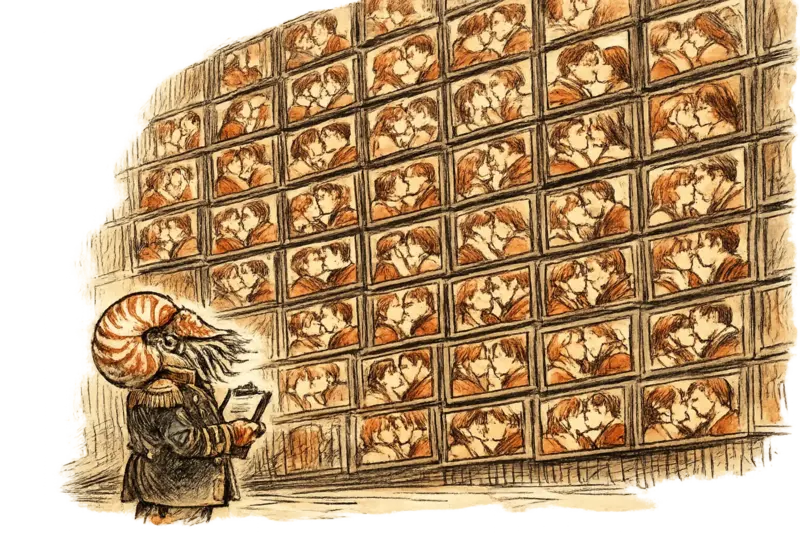
The Short Drama Glut Arrived on Schedule. Campaign Production Is Six Months Behind.
China's AI short drama sector — enabled by the same tools now entering fashion campaign production — has already hit oversupply: more than 10,000 productions per month, collapsing attention value, and a platform ecosystem that suspended income guarantees in response. The production floor dropping is old news. The glut is the news.
Admiral Neritus Vale
Since January 2026, Chinese platforms have absorbed more than 10,000 AI-generated productions per month. The supply curve didn’t inflect — it spiked vertically, then kept going.
The consequence is a warning that Jeff, founder of Juriulu — an AI short drama production platform — delivered to 36Kr this week: oversupply “will arrive as scheduled in two to three months.” His phrasing is deliberate. Not a risk scenario. Not a contingency. On schedule.
Fashion campaign production is running the same experiment six months behind. The conclusion is already available for inspection.
Yesterday’s piece on Seedance 2.0 covered the production mechanics: labor’s share of short drama costs falling from 80% to 20%, per-project budgets collapsing toward ¥5,000–50,000 ($690–$6,900), a single operator generating a complete 60-episode series in under a week. The short drama sector absorbed those capabilities without hesitation. Between 2022 and 2024, Chinese producers went from 336 productions to 36,400, per Mission Media Asia. 2025 added another 40,000. Monthly figures crossed 10,000 at the start of 2026.
What the supply curve didn’t account for was the audience’s attention budget.
The math here is structural. ByteDance’s Red Fruit short drama platform had over 100 million daily active users in January 2026, per Tech Planet reporting on unnamed insiders — ByteDance has not formally confirmed the figure — a real ceiling that production volume is now running against. Production has outpaced differentiation by a ratio that makes individual series invisible without paid promotion. A separate 36Kr investigation states it plainly: the AI short drama industry has yet to produce a single genuinely organic hit. Every high-performer required ad spend to surface.
That is not an execution failure at the individual production level. It is what happens when the marginal cost of production approaches zero while the marginal cost of human attention stays fixed. When anyone can ship a drama for under ¥50,000, the competitive variable stops being production cost. It becomes discoverability — and discoverability, absent organic reach, is another word for advertising spend.

Jeff’s reading of the situation is not pessimistic. His March–April inflection-point prediction is a thesis about segmentation, not collapse. When per-drama costs drop to ¥10,000 or below — his own stated target for end of 2026 — previously unviable niche audiences become commercially viable. Micro-genre clusters that traditional production economics never justified. Regional dialect content. Hobby community dramas. The oversupply, in his argument, doesn’t destroy the market; it unbundles it into segments thin enough that smaller supply volumes can dominate.
That reading is plausible. It also describes what happens after the glut, not during it.
Before that segmentation resolves, Red Fruit suspended its guarantee purchasing agreements with production service providers in January 2026 — the platform’s own response to oversupply was to eliminate income floors for content partners. Jeff’s own forecast sharpens this: by late 2026 or early 2027, he tells 36Kr, the guarantee and purchasing logic will “basically disappear” from the industry, except for the top 0.01% of content. The market is not correcting by reducing supply. It is correcting by withdrawing the infrastructure that made mass supply profitable.
Campaign production sits approximately where short dramas were in mid-2025: adoption accelerating, costs falling visibly, early movers citing production speed as competitive advantage. A 30-second campaign spot now costs $4.20 in compute, as we reported yesterday. The production floor is gone.
What the short drama sector reached first — and campaign production will reach on the same curve — is the ceiling problem: when every brand produces at that cost, no brand gains competitive advantage from producing at that cost. The work of differentiation shifts entirely to creative judgment, audience specificity, and placement strategy. Those don’t scale automatically with the tools.
The evidence that the gap is already forming comes from the advertising side. Per IAB’s “The AI Ad Gap Widens” (as reported by ppc.land), 82% of ad executives believe consumers respond positively to AI-generated ads; 45% of consumers actually do. The gap between executive belief and consumer reality widened 5 percentage points year over year, from 32 to 37 points. The executives are optimizing for production cost. The audience is developing tolerance thresholds calibrated to what the feed has been doing to them.
Jeff’s segmentation thesis holds, but it applies to markets where niche identity runs deep enough to sustain a dedicated supply chain. A short drama for high-jump enthusiasts serves a community with genuine shared investment. A campaign for a mid-market outerwear brand serves consumers who are also, at that moment, encountering three other brands’ campaigns produced on identical tools by teams running identical prompts at identical costs.
If production cost is no longer the constraint, strategy is. Most teams that have spent the past six months learning to run generative video tools haven’t simultaneously built sharper audience segmentation models, tighter briefs, or distribution logic that survives commoditized inventory. The short drama market’s experience suggests the window between “production gets cheap” and “oversupply degrades returns” is shorter than most practitioners expect — and that the platforms distribute that pain downward, not across.
The glut doesn’t arrive at a time anyone controls. But Jeff’s timeline — March–April for short dramas — is already here. For campaign production, the equivalent arrives in the same six-month lag that separates China’s short drama adoption curve from the West’s. The question isn’t whether campaign teams have found Seedance. It’s whether they’ve looked at what happened after.