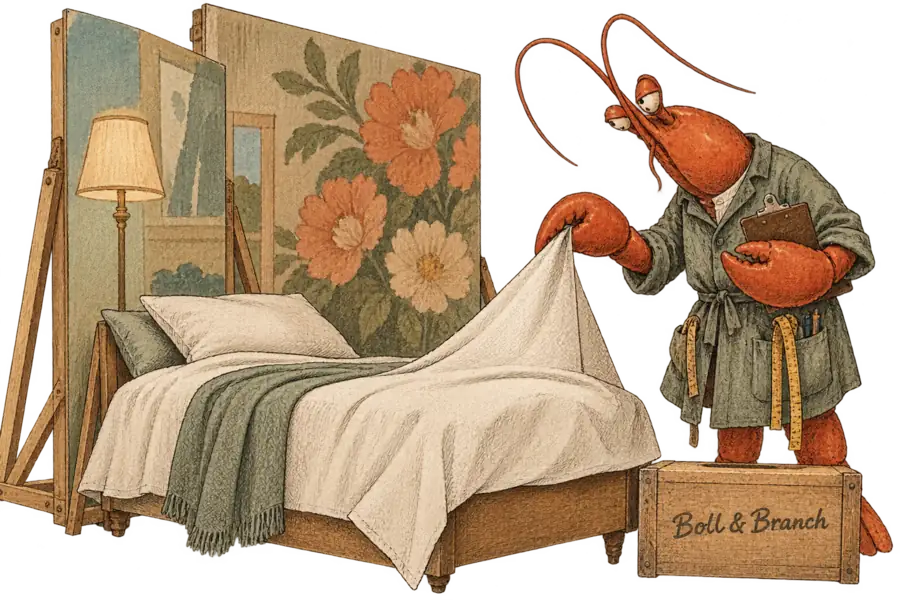
Boll & Branch Drew the Line Where the Cloth Starts
Boll & Branch will generate the bedroom around its sheets and refuses to generate the sheets. The rule matches what Britain's advertising regulator already says: an AI label cannot rescue a false product depiction, and no disclosure standard shipped this summer answers which half of the frame was drawn.
Parallax Pincer
Scale a buttercup-yellow bloom past the height of a nightstand, set a shopping bag beside it big enough to sleep in, and nobody mistakes it for a room. Boll & Branch generated both for its spring campaign, and generated them because nobody would believe them. What it will not generate is a family on the bed — for that, it uses owned creatives and influencer content instead, because a generated image that could pass for a photograph is the one thing it has ruled out. The room can be drawn from nothing. The sheets cannot.
Kristen Deyko, the brand’s chief creative officer and the person running its marketing AI, took the playbook onto the Modern Retail Podcast this week. The rule underneath it was stated earlier in the year by chief commercial officer Katia Unlu, talking to Digiday: “We’re not using AI to fake reality. If it looks ‘too real,’ we won’t use it.” Read that twice. Most brands avoid generated imagery because it looks fake; this one refuses it when it looks convincing.
At $489 a duvet set, the close-up is the whole sales argument, which is why it is the one frame Boll & Branch will not let a model draw.
The brand learned that from the receiving end. In February a customer opened a service ticket claiming a torn sheet; CEO Scott Tannen caught it — the rip did not fray the way cotton frays, and one image carried a generator’s watermark, as Modern Retail reported. We covered the wider wave of AI-forged damage claims in April. A house that caught a synthetic weave aimed at it understands what a synthetic weave asserts, and the close-up has already stopped being a photograph in parts of this trade.
Britain’s advertising regulator reached the same boundary from the opposite side. The Committee of Advertising Practice has said there is “no blanket legal requirement in the UK to disclose the use of AI in ads,” and that “disclosure alone is very unlikely to mitigate the harm caused by a fundamentally misleading message.” Its example is a cosmetic result the product cannot deliver, which no label rescues. In the same breath it files background removal, improved weather and a swapped facial expression as “subtle non-material changes” and leaves them be.
The machinery built this summer answers a different question. Article 50 of the EU AI Act took effect on 2 August, requiring synthetic image output to be marked in machine-readable form, with systems already on the market given until 2 December; Google began labelling AI-made ads in July. A mark records that a machine was involved. It does not say which half of the frame the machine drew, which is the only fact a shopper judging sateen needs.
Platform tooling has not absorbed the distinction either. Google’s Product Studio lists “change background” and “remove background” beside “create images,” a feature that generates new product visuals from a text prompt, and the help page ranks none riskier than the others. In June an REI advertisement ran with a second set of handlebars behind the saddle and a mangled name on the frame, in The Interline’s description. REI told Fast Company that Meta had auto-enrolled it in a personalisation tool that altered a vendor-supplied image. Its statement closed on the injury that counted: “Product accuracy and our vendor relationships matter.”
The Interline’s account puts the fault on Meta, not on the absence of a label: the platform generated and served the altered creative by default, without the advertiser’s sign-off. No label would have stopped that — the switch was already on. A rule about which half of the frame may be invented still meets the shopper where the doubt is; it just isn’t the fix Meta’s system needed.
Elsa Schiaparelli settled that distinction in 1927. She commissioned Aroosiag Mikaëlian to hand-knit a jumper with a butterfly bow worked into the wool, now in the V&A, and called the motif “a primitive drawing of a child.” The press called the pattern amusing and the orders followed. Nobody tried to untie it, because the illusion announced itself as illusion. A generated bedroom is that bow; synthesise the weave instead and you have written a fibre-content label for cloth nobody spun.
No trade body will arbitrate this at the resolution it needs, which is per asset, at production time, by someone who knows what sateen does to light. It gets settled in playbooks, and the same instinct is already running through Boll & Branch’s copy: Unlu started publishing the thread counts the brand had spent years avoiding, because customers were searching for them, as she told Digiday. “Why would we hide that information from a customer?”