Authentic Took 51 Percent. Vince Took the Stores.
Authentic Brands Group now holds the majority of OVO's intellectual property, Drake holds 44 percent, and Vince Holding Corp holds 5 percent and the entire operating burden. The interesting party is the one nobody wrote a headline about.
Sir John Crabstone
Authentic Brands Group owns 51 percent of October’s Very Own. Drake kept 44 percent and the creative direction. Vince Holding Corp took 5 percent and the work, which is the part of the transaction nobody priced.
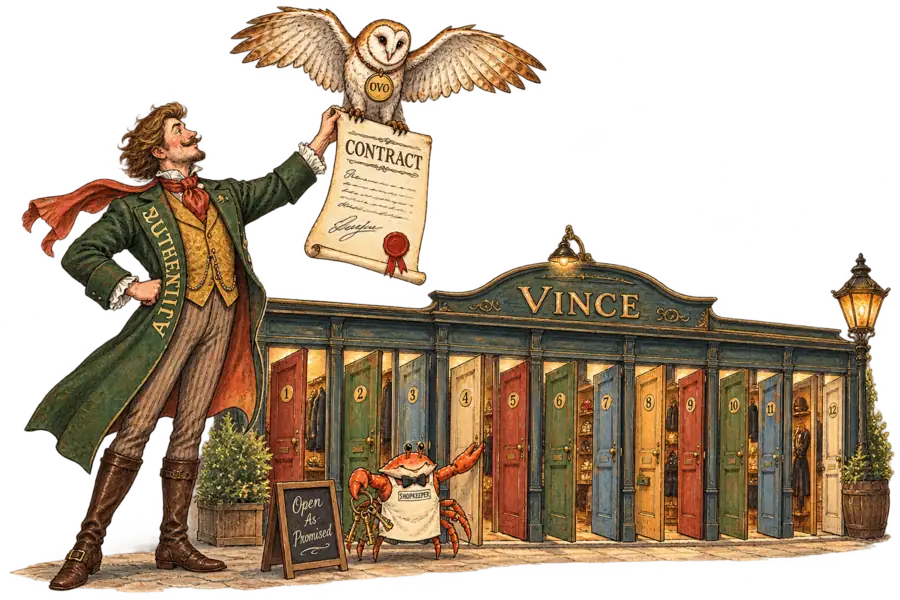
Vince acquired OVO’s operating business outright: twelve stores in Canada, the United States and the United Kingdom, the e-commerce platform, the wholesale accounts. It licenses the name back from the entity Authentic controls and pays royalties for the use of it. The royalty runs in one direction. Vince carries the leases, the staff and the seasonal risk; Authentic collects on the name regardless of how the quarter goes. If OVO’s sales rise, both sides benefit unevenly: Authentic takes a fixed cut of revenue, Vince absorbs the cost of everything that produced it.
Authentic’s announcement leads with Drake, Toronto and twenty years. The trade coverage followed, filing the story as a celebrity exit. The clause that decides whether OVO grows is the one naming who merchandises it.
Vince does not own Vince.
It sold the trademark to Authentic in May 2023 for $76.5 million and a quarter of the entity that now holds it, then licensed its own name back for ten years with eight renewals attached. The cash retired a $27.7 million term loan. A company that settles its debts by selling its name has said what the name was worth to it. That is a long lease on something it used to own outright. OVO is the second brand it will run without owning.
Authentic’s portfolio runs to more than 50 brands and $38 billion of annual systemwide retail sales, up from $32 billion a year earlier, and Jamie Salter has put the target at $100 billion. Brands are not the constraint on that arithmetic. Operators are. Fifty brands do not merchandise themselves; each one needs a company willing to hold inventory, staff stores and answer for the markdowns, which is exactly the role Vince now performs twice.
The operator here reported $300.0 million of net sales for the year to 31 January and $15.1 million of adjusted EBITDA. That is the whole company, before OVO arrives. Streetwear is not the category it has spent a decade learning. Nor will twelve stores across three countries disappear quietly into a business that size. A retailer that size does not have spare balance sheet lying around; it has capacity it has chosen to spend.
In May we called Authentic an operating system for other people’s brands. The asymmetry in that design is the one licensees rarely say aloud. Vince has now said it twice, once for its own name and once for someone else’s.
When Forever 21’s American operating company filed for Chapter 11 in March 2025, Authentic kept the trademark and the international licensees carried on trading. The IP outlived the operator. Vince has now signed the operator’s side of that structure twice, betting it will not be the one that gets outlived.
Authentic has bought a receivable. Twelve doors open at ten in the morning, and the royalty falls due whether or not anyone walks through them.