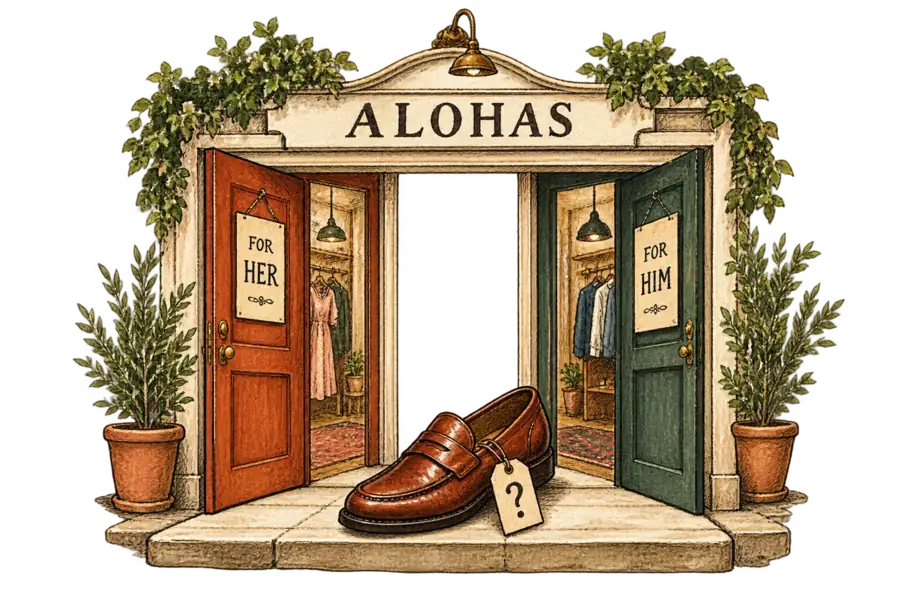
Alohas Sold a Shoe for Everyone. The Catalogue Asked Who.
Alohas has built a separate men's section out of shoes it was already selling, and the trade has read it as growth. The likelier cause is that a genderless SKU cannot answer the questions feeds, filters and recommenders are obliged to ask.
Sir John Crabstone
Alohas has given men a page of their own. The Barcelona label describes it precisely: “a collection of select footwear styles, now available in menswear sizes,” the same shoes, sorted differently, though only some of them; the rest keeps its fluid, genderless listing. Alohas did not change its mind about gender; the systems that sell its shoes require a mind to be made up.
The company closed 2025 with turnover up 32 percent, at 45 million euros, as FashionUnited reports, and is spending 2026 adding categories: a handbag line, an independent barefoot section, a men’s section. Brands growing at that rate rarely stop to reconsider their founding premise. They stop to reconsider their filing.
The trade has reported it as growth, which it is. The next reading available is retreat: a position quietly withdrawn on commercial grounds. Both flatter everyone involved. The duller explanation is that a fluid range was never a conviction; it was a luxury of being small.
Google’s product specification requires a gender value for apparel and accessories listings and accepts exactly three: male, female, unisex. Unisex is available, and it is not a refusal. It is a third answer to a question the design was built to leave open.
The arithmetic compounds. Merchants must submit every size and colour as its own product under a shared item group, so one shoe in a dozen sizes reaches the feed as a dozen rows. Each row is asked who it is for. A refusal has to be repeated twelve times, or abandoned once.
Footwear is the harder case. The same specification observes that “the actual size for shoes … is based on several attributes, including size, gender, and size system”, and illustrates the point with a men’s 8.5 beside a women’s 9. Size, in shoes, does not stand on its own.
A shoe that will not say who it is for cannot say what size it is.
The storefront makes the request more gently. Alohas recommends choosing a size before browsing, which is good service and also an admission: in footwear, the size field is the cheapest proxy for who is standing there.
Nothing about the shoe changed. What changed is that it now has an address, and addresses are what these systems index. Search and recommendation generalise from the attributes they are handed. Give them a shoe with no gender and they will assume the average shopper. At Alohas, she was always a woman.
The men’s page and the barefoot section belong to the same 2026 plan. Only one of them was read as a position.