The Allergy Aisle Quit Arguing About Efficacy. A Beauty Founder Collected.
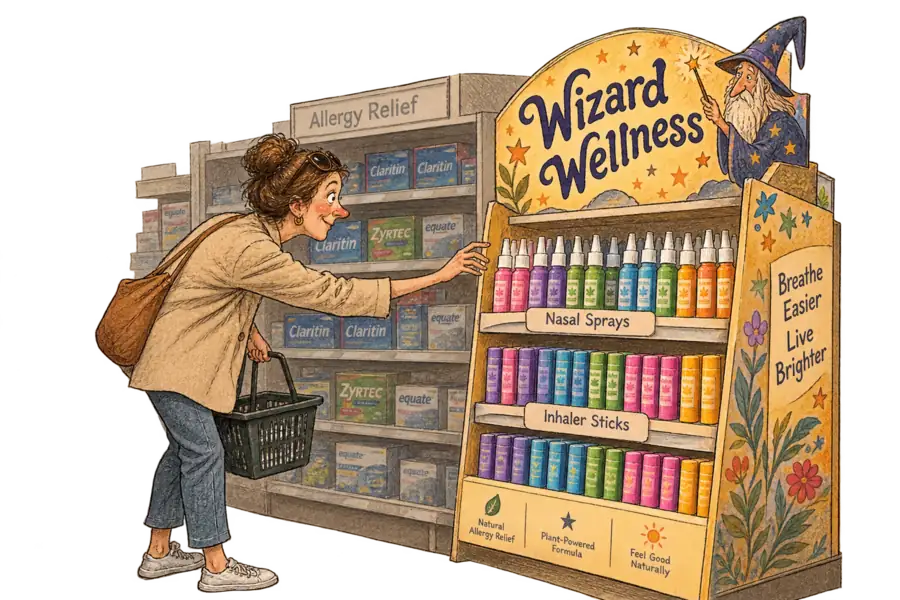
Wizard Wellness launched direct-to-consumer in January and now sits in more than 4,000 Target, Walmart and CVS doors on projected revenue of $2 million to $5 million. The beauty go-to-market has become portable, and the allergy shelf had nothing left to defend.
Sir John Crabstone
Wizard Wellness now holds more than 4,000 Target, Walmart and CVS doors, a national rollout it completed in four weeks alongside a $1 million round. The speed makes more sense once you know why retail mattered so much: 84% to 96% of allergy purchases happen in-store, depending on retailer, per Numerator. Beauty brands rarely move that fast for a reason this mundane.
Wizard sold its first nasal spray in January; its founder, Lorne Lucree, spent two decades developing products across Procter & Gamble, L’Oréal, Estée Lauder and Unilever Prestige. What he carried into the allergy aisle was the beauty go-to-market, and the thing travels. BeautyMatter puts the brand’s projected 2026 revenue between $2 million and $5 million, and roughly 1,500 of those Walmart stores handed it an endcap. Its subscription base has grown seventeenfold since January. Endcap used to be earned by moving cases; Wizard moved a premise. Lucree is less triumphant about it than the shelf suggests, calling the choice to build a category rather than borrow one “a much tougher road.”
The aisle it entered had already surrendered its own argument. Numerator found in 2024 that 72% of allergy buyers rate store brands and national brands identical in quality. Three-quarters say advertising does not move them. Walmart’s Equate trails Claritin by 1.3 points of category spend. Decades of clinical claims produced a shopper who cannot tell Zyrtec from the box beside it and has stopped pretending to.
Efficacy stopped being an argument in that aisle years ago; the shelf has been waiting for somebody to ask a different question.
The trade reading is that microbiome science has arrived in nasal care. The beauty press, covering the January launch, called it the Starface treatment, which is nearer the mark and still short of it. Starface did not make hydrocolloid work better; it made a bandage something you would let a stranger see on your face. Wizard has done that for a product whose entire design brief was concealment.
Lucree’s own explanation gives the mechanism away. “Beauty taught us that people will not use something twice if it doesn’t feel good,” he said in August. “The nose has never been held to that standard.” That is a repeat-purchase forecast dressed as a sensory claim, and the buyers in Bentonville read it correctly.
The incumbents cannot answer at this speed, and the obstacle is not imagination. A drug brand’s differentiation sits in a monograph and a label that took years to clear. Wizard’s sits in a flavour name, Glacial Mint, and a shade of packaging, both changeable on a Tuesday. Making a drug-free spray pleasant is a marketing decision; making an antihistamine pleasant is a regulatory project.
Target stocks three of its products, at $14.99, $10.99 and $9.99. Those are beauty prices in an aisle that taught America to buy the generic. Whether nasal wellness becomes a category in its own right, rather than one brand’s good year, is not yet proven, even by BeautyMatter’s own account. Any shelf where incumbents won the efficacy argument too completely is open on those terms. Allergy was not the softest of them.