AI Took the Search Engine's Job in Onward's Survey. Fit and Suitability Topped the Jobs Left to Shop Staff
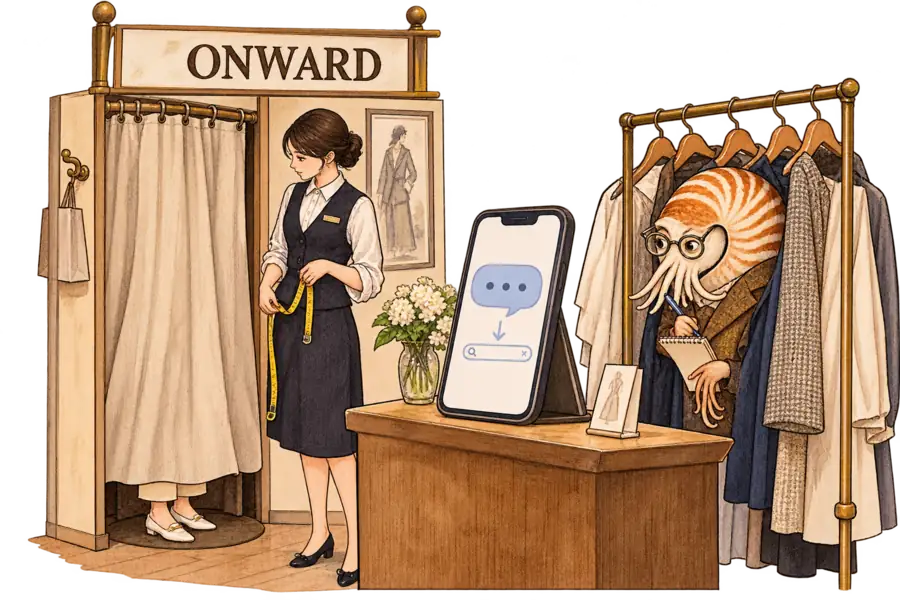
In Onward Holdings' 606-person panel survey, 59.0% of those who had consulted AI about clothes said it had replaced looking things up on search engines, and 9.8% said it had replaced asking shop staff. Size, fit and suitability led what they say staff still do better, the check Onward's Click & Try try-on service offers.
Neritus Vale
Onward Holdings, a Japanese apparel group that sells mostly through shops, polled 606 people and found AI displacing the search box far more often than the shop assistant. Of respondents who had consulted AI before buying clothes, 59.0% said AI had replaced looking up products and information on search engines, the release shows. For them, a chat window now does the search box’s first job. Asking shop staff was on the same list, and 9.8% had given it up. The release gives no base for how many used to ask staff.
What they still want a person for is judging the body in the garment. Asked where they think staff beat AI, the same respondents put checking size and fit first, at 46.1%, just ahead of an objective view of whether something suits them. Fabric feel and comfort followed: answers that need the clothes in hand, or a second pair of eyes. Only 8.4% said staff did nothing better, the release shows.
Onward has a stake in that answer: shops still carry most of its sales in Japan. Physical channels, department stores included, took 72.4% of sales at its Japanese companies that sell online in the six months to August, its results presentation shows. Its Click & Try service sends clothes reserved online to a nearby shop for trying on. It ran in 435 shops at the end of August.
The questions came from the seller. Onward’s corporate communications office ran the survey for its Marketing Lab series and published it on 19 November on its subsidiary Onward Kashiyama’s site. It polled 606 men and women, aged from their teens to their sixties, between 2 and 9 November. Answers came through knowns, which its App Store listing describes as a survey app that pays users in coins.
Nobody should read this panel as Japan. In it, 88.1% said they had used AI. Onward never defines the term. In the survey behind the communications ministry’s 2026 white paper, which asked about generative AI, 58.8% had used it. Different questions make the gap a warning rather than a measure.
The headline needs its base too. Onward’s headline figure is 356 of the 534 AI users, those who had consulted AI before buying clothes. That makes it a share of AI users, not of the panel. Of everyone polled, they are 58.7%, a figure the release never gives. Its opening line instead says 「全体の約67%」 (about 67% of the whole), which is 356 of 534 under a label that reads like all 606. Dellows News put the search-engine figure on all AI users; in the release, only the chart caption gives its base.
Most of those who had consulted AI picked a search-like style as closest to how they use it. Setting conditions, as in Onward’s example of a jacket for work within a budget, drew 33.1%. That is a search with the filters typed out as a sentence. Plain search, such as asking what to wear on a light hike, came next at 31.5%.
Neither staff question is clean. The release never says how many used to consult staff, so a low share may reflect a rare habit as much as a sturdy one. It also lists staff among the four items it calls hard for AI to replace, but a bottom place on that list says little about how many ever asked. The staff question carried its premise in the phrase “AIにまだ足りない部分で” (where AI still falls short), inviting respondents to find a gap. What survives is the ranking: size, suitability and fabric sit above outfit ideas and reading preferences from conversation, which a chat can supply in words.
The release’s boldest claim rests on its weakest inference. One heading says the busier people are, the more they use AI to choose clothes. The evidence is that 67.7% of those who had consulted AI said they were very or somewhat busy. That describes the consulters; with no figure for anyone else, it cannot show that busy people consult more. The release’s “約2倍” (about twice) sets that share against the rest of the same group, its own complement.
Onward’s own figures show how big the try-on step is. In the six months to August, Click & Try customers reserved 142,510 items to try on, up 0.4%, the results presentation shows. Trying on is where a choice made on a screen meets a body. Sales through the service came to ¥1,271m, against group sales of ¥103,106m.
Onward has linked Click & Try to AI only in passing. Asked about weather risk on 9 October, it said Click & Try lets customers try on warehouse stock in its shops, its briefing’s Q&A summary records. It added that it wants to consider new OMO measures, merging online and offline, that also use AI. The summary names none.
The strongest objection is that the staff’s lead belongs to this year’s software. A fifth of those who had consulted AI picked judging between candidates as closest to their use, as in Onward’s example “この2つなら、どちらが自分に合う?” (of these two, which suits me?). That question has already moved to the chat. And 49.6% of all AI users say AI can already personalise suggestions, while 62.2% think it will tailor them to body type, taste and wardrobe within a year or two. For the thesis to fail, chat would have to answer size and suitability so well that shoppers stop asking a person.
ZOZO, which runs Japan’s largest fashion e-commerce site, is betting on suitability. It has built its agent plans around 似合う (niau), whether clothes suit the wearer, WWD Japan reports. Its LINE chatbot already proposes outfits that suit, and a virtual try-on mirror for shops is in development. Onward’s respondents give that bet no support yet: all 356 had consulted AI about clothes, yet they still ranked size and suitability first among what staff do better. They are saying what they believe, not reporting a measured failure of AI.
In this panel, AI has taken the part of shopping that never needed a body.
If chat keeps absorbing search and comparison, each clothing retailer must decide where its AI sends a shopper after the answer. A parcel comes back when the size is wrong. A WWD Japan column names size as the main cause of returns, citing Coresight Research figures for the US: apparel returns of 23.4%, with about 70% of returners citing size or fit. Onward already sells the alternative, a fitting room with a person beside it, and its survey reads like the case for building AI to match.