AgenticRecTune Tuned Five Agents. The Recsys Lift Moved Off The Model.
Google's AgenticRecTune relocates the recsys gain from inside the ranker to the configuration glue between pre-rank, rank, and re-rank. Retailers running the same cascade will see the architecture choice in latency, freshness, and assortment behaviour.
Admiral Neritus Vale
Google’s recommender team has published a paper that admits the next lift in industrial recsys no longer lives inside the model. AgenticRecTune, deployed in a production recommendation system, frames the pipeline as five LLM agents tuning fusion weights and routing thresholds between pre-ranking, ranking, and re-ranking. The reported gains arrive without retraining any retrieval model. For retailers running the same cascade, the margin left in the system has moved out of the ranker.
Posted on arXiv in April by Xidong Wu and colleagues, the paper names its five Gemini-backed agents Actor, Critic, Insight, Skill, and Online. Actor proposes configurations; Critic prunes them against guardrails before any traffic touches the system. Online runs the A/B tests autonomously, while an Insight–Skill loop maintains what the authors call a “self-evolving Skillhub” — a memory of what has worked, organised by stage. The framework optimises the value-fusion weights at retrieval, the score-combination logic across the ranker’s multiple objectives, and the diversity policy at re-rank. It does not retrain anything. It coordinates.
The bottleneck has moved because the recsys pipeline stopped being a single ranking problem and became a coordination problem that no team owns end-to-end.
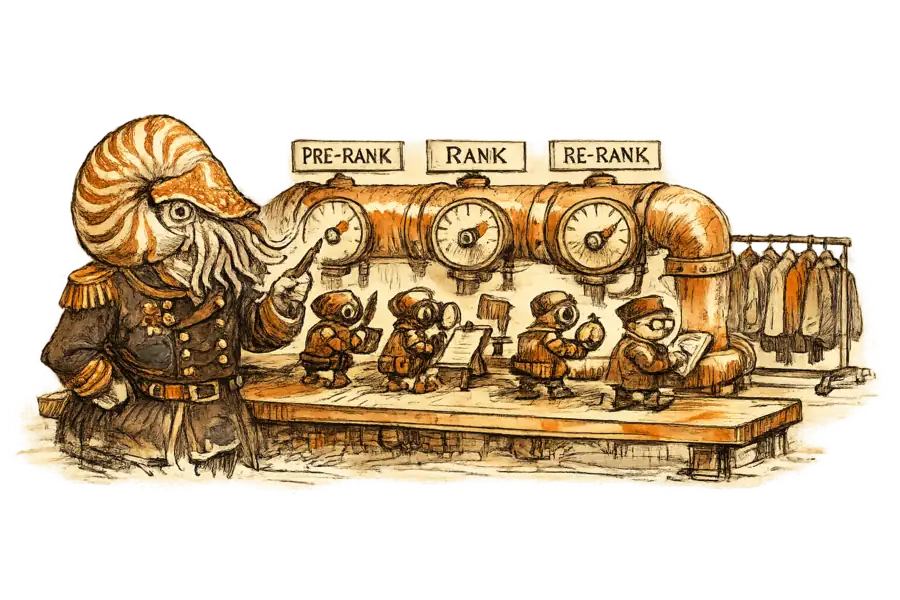
Industrial recsys split into stages long ago, and each stage has since acquired its own team and its own loss function. Pre-rank optimises cheap recall across millions of candidates. Rank optimises a multi-objective score combining click probability, dwell, conversion, and return likelihood. Re-rank enforces diversity, business rules, sponsored-slot quotas, and freshness windows. The handoffs between these stages — the score fusions, the routing thresholds, the candidate cuts — are configured manually, audited rarely, and tuned by whoever last filed a ticket. Google’s argument is that the handoffs are now the largest pool of un-extracted gain in the system, and the pool is too big to keep handing to humans.
The honest counter is that this matters at scale and almost nowhere else. AgenticRecTune was built for a system handling enough volume to run many parallel A/B slots and still leave the Critic agent something to learn from. A mid-sized retailer cannot resolve a marginal engagement lift against its noise floor in any reasonable time, which means the agents propose into silence. The condition under which this thesis fails is straightforward: if traffic is too thin for autonomous A/B, the architecture is research, not deployment. The design assumes the volume.
Where the thesis holds, the architecture leaks into the customer experience. A pipeline tuned by autonomous agents shows three signatures from outside. Latency variance starts to compress because the Critic prefers routing thresholds it has previously seen stabilise. The assortment freshens visibly between weeks once the diversity policy is no longer the parameter someone forgot to revisit. Session-to-session reordering accelerates as the Skillhub remembers which configurations worked for cohorts the team has not yet defined. Retailers running manual fusion weights, quarterly tuning cycles, and a single re-rank policy across surfaces will look slower and stiffer next to peers who have moved.
Catalogues in apparel punish the re-rank stage harder than most verticals, which is where this architecture becomes visible first. Categories like dresses carry heavy SKU overlap, near-duplicate listings across colourways, and seasonal turnover that makes diversity policy load-bearing rather than cosmetic. Zalando’s December 2024 work on graph neural networks and Stitch Fix’s documented blend of collaborative filtering, latent preference modelling, and human-in-the-loop curation show that the bones of a multi-stage cascade are already in place across the category. The question is who installs the agent layer above the bones. The retailers who do will see lifts on diversity, freshness, and long-tail exposure that have resisted single-model optimisation for years.
None of this requires a new ranker, and that is the point. If a retailer continues to treat recsys as a model problem, its data scientists will keep chasing small offline lifts that fail to replicate online. The coordination view spends the same headcount differently: fewer experiments per quarter, more of them shipped, configurations that compound. If the architecture works as the paper suggests, the choice will appear in the feed before it appears in an earnings call. That is the order in which most architectural decisions in retail eventually announce themselves.