£34 Billion Cleared Through Britain's Marketplaces Under No One's Channel Plan
Marketplaces and peer-to-peer platforms moved £34.1 billion of goods in Britain last year, and neither the statistical agencies nor the brand org charts have a category for the sellers behind them. Eurostat's two measures of marketplace dependence don't move together, which makes a single continental average a number no country actually hits.
Admiral Neritus Vale
Third-party sellers are now a national retail channel in Britain, and almost nobody staffs them as one. Marketplaces and peer-to-peer platforms cleared £34.1 billion of goods in the UK last year, just under a third of everything the country spends online, on Mintel’s count. That is a trading channel the size of a major grocer, assembled from firms with no key account manager, no trading calendar and no line in anyone’s European plan. Growth in the channel slowed to 3.7% in 2024–25, Mintel’s own figures show, lagging the wider e-commerce market: this is a large base, not an accelerating one. The plan is where the damage compounds anyway, because the weight marketplaces carry varies so much between European countries that a single continental figure describes none of them.
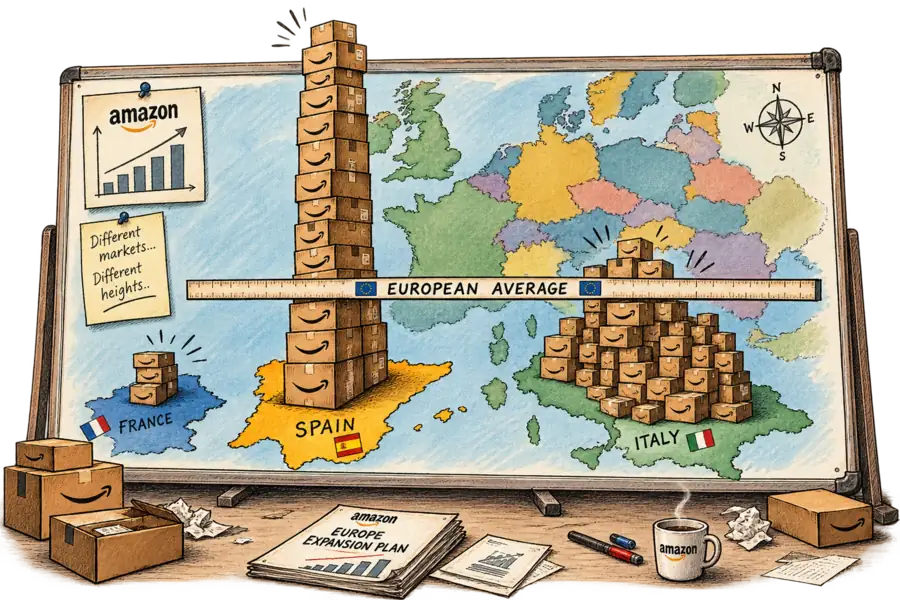
Eurostat measures this directly, and the spread is wider than any pan-European deck admits. Firms with ten or more staff across the EU took 1.30% of their total turnover through e-commerce marketplaces in 2024, a figure small enough to read as noise and large enough to fund a department. Lithuania alone took 5.21% of turnover through marketplaces that year, four times the EU figure, which is the whole argument in one comparison. That average is still what most European channel plans are implicitly sized against, because it is the only number anyone quotes.
It describes no member state at all.
The deeper trap is that Eurostat publishes a second marketplace measure, and nothing requires it to move with the first. This one counts how many online-selling firms use a marketplace at all, not how much revenue passes through it. Italy leads the large economies on that count, with 65.06% of web-selling firms using a marketplace against an EU average of 45%. Lithuania is the only country to top both rankings: 86.55% adoption and 5.21% of turnover. Italy comes close on adoption but nowhere near on turnover, where Eurostat names no country besides Lithuania. Counting sellers and counting revenue are different exercises, and a plan built on one will misjudge the other.

The strongest objection is that Eurostat is measuring the wrong economy. Its sample spans manufacturers, wholesalers and service firms with ten or more staff rather than consumer retail, and a German toolmaker’s marketplace turnover tells a clothing brand nothing. For the objection to carry, marketplace dependence in consumer retail would have to be roughly even across Europe while remaining uneven across the wider economy. That is a real possibility, since Amazon runs the same assortment and the same Prime terms in every market it operates. It fails on the evidence: were the platform alone setting dependence, adoption and turnover share would move together country by country, and Italy is the counter-case, high on one measure and unremarkable on the other. What varies is national market structure, which does not converge because a slide deck says Europe.
Britain’s own figure is the clearest evidence that nobody owns this channel. Mintel’s count excludes VAT and includes private resale; the ONS counts retail sales and reported that 28.3% of them happened online in December 2025, without recording who sold the goods. Move those definitions around and third-party sellers are worth anywhere between roughly three pence in every pound of British retail and roughly nine. No agency publishes a settled figure because no agency has a category for one, and no brand pursues the channel because a channel without a number never gets a budget line.
Amazon supplies the only firm anchor in the picture, and it is a company statement rather than an audited series. Independent sellers account for more than 60% of sales in its store, a share Marketplace Pulse independently estimates at 69% of gross merchandise value once the count is weighted by money rather than units. The two land close enough to trust the order of magnitude and far enough apart to show that even Amazon’s own denominator is contested.
More than 85,000 of those UK sellers are small and medium-sized businesses, and most European org charts contain nobody whose job is to know their names.
The correction is cheap, which is the strongest argument for making it. Eurostat publishes both measures free, the ONS bounds the British online share every month, and sizing a marketplace plan country by country costs a week of analyst time. If adoption and turnover share keep diverging as they did in Italy in 2024, a brand running one European marketplace headcount will misread every market where the two measures disagree. That is not a forecast about platforms; it is arithmetic about budgets. The choice is whether to plan against the numbers you can look up, or one you invented by averaging them.